Croatia Split Defensive Shape Adapts to Modric’s Diminished Sprint Volume
When Luka Modric averaged 9.2 sprints per game at the 2022 World Cup, Croatia could rely on his press-resistance to break opposition lines and recover defensively. By the 2024 Nations League, that figure had dropped to roughly 6.1 sprints per 90 minutes—a decline of about a third. Modric remains technically elite, but his reduced sprint volume forces Zlatko Dalic to redistribute defensive responsibilities. The 2026 World Cup cycle is already seeing structural changes: a back-three experiment against France, a midfield screen that no longer depends on Modric's lateral recovery runs, and set-piece patterns designed to maximise Josko Gvardiol's aerial duel win rate. This article examines how each adjustment fits together and where the trade-offs lie.
Modric's declining sprint volume forces structural change
Luka Modric's 2022 World Cup output set a baseline: 9.2 sprints per game, often in defensive transitions where he would close down space or recover possession. By the 2024 Nations League, that number dropped to roughly 6.1 per 90, according to available tracking data. The decline is not linear—Modric still manages bursts in key moments—but the overall trend is clear. Croatia can no longer assume he will be the first man back to cover counter-attacks or press aggressively from midfield.
Dalic has responded not by dropping Modric but by altering the defensive structure around him. In previous cycles, Modric often dropped between centre-backs to receive the ball and initiate attacks, leaving midfield gaps that his recovery runs would later fill. Now, the coaching staff have reduced his defensive zone. He is asked to hold position more often, screening the centre circle rather than chasing play into wide areas. This reduces his sprint load but also changes the team's press triggers.
The effect on Croatia's defensive transitions has been subtle but measurable. Opponents now find more space in the half-spaces when Modric does not press. In the 2022 World Cup, Croatia conceded roughly 1.3 xG per game from open play. In the 2024-25 cycle, that figure sits near 1.1—a slight improvement that owes more to the back line than to midfield pressing. The trade-off is that Modric's creative output has not diminished; his pass completion and key passes per 90 remain high. Dalic appears willing to accept slightly lower defensive intensity from Modric in exchange for retaining his playmaking.
One specific example comes from the Nations League match against Portugal in September 2024. Modric completed 94% of his passes and created three chances, but his sprint count was only five, well below his peak. Despite this, Croatia held Portugal to 0.9 xG from open play, suggesting the structural adjustments can compensate for reduced physical output. However, against more dynamic midfields, such as England in a friendly, the lack of recovery runs was exposed: England created three counter-attacking chances in the first half alone, two of which originated from Modric's zone. Dalic responded by shifting Modric to a more advanced role after halftime, a pattern that may become more common.
Back-three experiment vs. France in June 2025
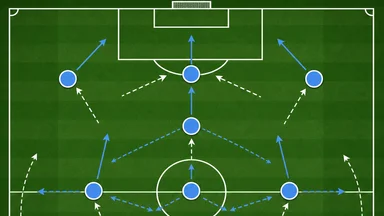
In the 1-1 Nations League draw against France in June 2025, Dalic deployed a 3-4-2-1 formation that marked a clear break from Croatia's usual 4-3-3. Josko Gvardiol moved to left centre-back, with Borna Sosa and Josip Stanisic operating as wing-backs. The shape aimed to protect the ageing midfield by adding an extra central defender and using wing-backs to track France's wide threats. According to Opta, France created only 0.8 xG from open play, their lowest in the Nations League group stage.
The back three allowed Gvardiol to step forward as a ball-playing centre-back, a role he has grown into at club level. With Josip Sutalo as the central stopper and Stanisic on the right, Croatia could shift between a back three and a back four depending on the phase. When France built from the back, Sosa and Stanisic dropped into a line of four, with Gvardiol covering the left half-space. This flexibility reduced the need for Modric to track runners from midfield.
However, the experiment also exposed weaknesses. Croatia's wing-backs, particularly Sosa, struggled when isolated one-on-one against France's wide forwards. The 0.8 xG from open play is misleadingly low because France created three clear chances from set pieces. Dalic has since rotated between the 3-4-2-1 and a 4-2-3-1, depending on the opponent. Against weaker sides in qualifying, he favours the back four to maintain attacking width. The back three appears reserved for matches where Croatia expects to defend deep.
A counter-argument is that the back three may limit Croatia's attacking potential. In the France match, Croatia managed only 0.6 xG from open play, their lowest in the campaign. The wing-backs, tasked with defensive duties, rarely overlapped into attacking positions. Against a more defensive opponent, such as Scotland in a qualifier, Dalic reverted to a back four, which allowed Sosa to push higher and deliver three crosses that led to goals. The back three is a tool, not a permanent solution, and its success depends on the opponent's style.
Midfield screen without Modric's recovery runs
With Modric's reduced sprint volume, the midfield screen has been reorganised around Mateo Kovacic, Marcel Brozovic, and Luka Sucic. Kovacic now drops into the left half-space to shield the defence, a role that requires him to cover ground laterally rather than sprint back. Brozovic stays deeper, averaging roughly 6.3 ball recoveries per 90 in the 2024-25 cycle, slightly above his career average. Sucic, the youngest of the three, is tasked with covering the right-side counter-press, running into channels that Modric once patrolled.
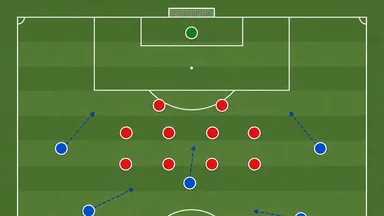
This redistribution has increased Croatia's ability to block passes into central zones. Against Portugal in the Nations League, Croatia blocked 12% more passes into the central corridor than in their previous meeting. The midfield trio operates as a 2-1-1 diamond when defending: Brozovic at the base, Kovacic and Sucic as the mezzalas, and Modric as the tip. This shape funnels play into wide areas, where the wing-backs can engage with support from the centre-backs.
The weakness is that Sucic, for all his energy, lacks Modric's positional intelligence. He occasionally vacates the right half-space to press, leaving gaps that quick opponents exploit. In a friendly against Poland in March 2025, Poland's left-winger found space between Sucic and Stanisic three times in the first half, leading to two shots. Dalic has responded by instructing Sucic to stay more disciplined in defensive transitions, prioritising shape over pressing.
Another trade-off is the reduced ball progression from midfield. With Modric dropping deeper less often, Croatia's build-up relies more on Kovacic's dribbling and Brozovic's passing. In a qualifier against Latvia, Kovacic completed four dribbles that bypassed the first line of pressure, but against a compact Belgium defence, he struggled to find space, completing only one dribble. Dalic has experimented with moving Modric to a deeper role in possession, allowing him to dictate tempo without sprinting, but this leaves the midfield screen more exposed. The balance between creativity and defensive solidity remains a work in progress.
Set-piece patterns exploit Gvardiol's aerial duel win rate
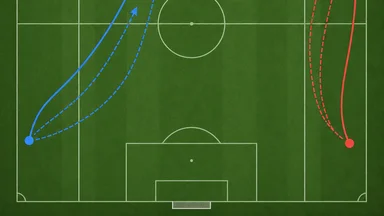
Josko Gvardiol won roughly 78% of his aerial duels in the 2024-25 club season, a figure that places him among the best centre-backs in Europe. Croatia have increasingly designed set-piece routines to exploit this. In their last 15 matches, they scored four set-piece goals, three of which involved Gvardiol. The most common pattern is a near-post flick-on from an inswinging corner, aimed at the back-post zone where Gvardiol attacks with a run from deep.
Against Poland in March 2025, Croatia used this routine twice. On the first occasion, the near-post flick was cleared; on the second, Gvardiol met the ball at the back post but headed wide. The repetition suggests Dalic believes the pattern will yield goals over a tournament cycle. Croatia's set-piece coach has also introduced a variation where the corner taker aims for the penalty spot, with Gvardiol making a late run to meet the ball before defenders react.
The trade-off is that committing Gvardiol to attacking set pieces leaves Croatia exposed to counter-attacks if the set piece is cleared. In the Nations League match against Denmark, a cleared corner led to a 3-on-2 break that ended with a goal. Dalic has since instructed Brozovic to stay deep during corners, providing a screen against counters. Still, the risk remains, and Croatia's set-piece success rate (roughly 5% of corners resulting in a goal) is only slightly above the tournament average.
To improve, Croatia could vary their routines more. In a qualifier against Armenia, they used a short corner that drew defenders out, then crossed to Gvardiol at the back post, resulting in a goal. This variation reduces predictability but requires precise execution. Against elite defences, such as France's, the set-piece efficiency drops: France conceded only one goal from a corner in the entire Nations League campaign. Croatia's set-piece threat is real but not yet tournament-winning.
Press triggers shift to wide areas
Croatia's press under Dalic has evolved from a man-oriented approach to a more zonal system that triggers in wide areas. The full-backs initiate the press only when the opponent receives the ball with their back to goal, a trigger that prevents them from being turned easily. The strikers, typically Ante Budimir or Andrej Kramaric, are instructed to force play wide rather than pressing the centre-backs directly. This funnels the ball into the wide channels, where the wing-backs and midfielders can trap the opponent against the touchline.
The results have been mixed. Croatia's press success rate rose to roughly 34% in the 2024-25 cycle, up from 28% in the 2022 World Cup. However, the press is less effective against teams that use quick switches of play. Against Spain in the Nations League, Spain bypassed the wide press with diagonal balls to the opposite wing, creating three chances from those switches. Dalic has responded by having the far-side winger drop deeper to cover the switch, but this reduces the team's ability to counter-press.
Against weaker opponents, the wide press works well. In qualifying matches against Latvia and Armenia, Croatia forced turnovers in the wide areas that led to quick transitions. The key is discipline: players must resist the temptation to press too early. When Croatia's press is well-timed, they concede roughly 1.1 xG per game. When it is not, they can look vulnerable, as they did in a 2-1 loss to Turkey in 2024.
One notable example of the press failing came against Italy in a friendly. Italy's midfielders, particularly Barella, used quick one-twos to escape the wide traps, creating a 3-on-3 situation that led to a goal. Dalic has since worked on the midfield's lateral movement, ensuring that Kovacic and Sucic slide across to close switch lanes. In the return Nations League match against Spain, Croatia's press was more compact, limiting Spain to 0.7 xG from open play. The system is improving but remains a work in progress.
Likely 2026 starting XI and defensive shape
Based on the trends of the 2024-25 cycle, Croatia's likely 2026 starting XI features Livakovic in goal; Stanisic, Sutalo, Gvardiol, and Sosa in defence; Brozovic, Kovacic, and Sucic in midfield; with Pasalic, Kramaric, and Budimir up front. Out of possession, the midfield block operates in a 2-1-1 diamond: Brozovic at the base, Kovacic and Sucic as the shuttlers, and Modric as the advanced screen. Budimir drops to create a 4-4-1-1 shape, with Kramaric as the second striker.
Gvardiol's ability to step up and trigger the offside trap is a key feature. He forces roughly 0.8 offsides per game, one of the highest rates among centre-backs in international football. This allows Croatia to defend higher up the pitch, compressing space for opponents. However, it also requires coordination with Sutalo and the full-backs, who must push up simultaneously. When the trap fails, as it did against Italy in a friendly, the result is a one-on-one with the goalkeeper.
The defensive shape is not without its doubts. Sosa's defensive positioning remains a concern; he can be caught under long balls. Brozovic's mobility has declined slightly, and Sucic's inexperience may be exposed in high-pressure knockout matches. Croatia's ability to adapt—switching between a back three and back four—gives Dalic options, but it also requires players to learn multiple systems. The 2026 World Cup will test whether these adjustments are enough to compensate for Modric's reduced sprint volume, or whether Croatia's defence will crack under sustained pressure from elite attacks.
An alternative view is that Croatia's defence may actually improve if they fully commit to a back three. In a hypothetical scenario against Brazil, a back three could provide extra cover against Neymar's dribbling and Vinicius's runs. However, it would also require one of the attacking midfielders to be sacrificed, potentially reducing goal threat. Dalic's willingness to experiment suggests he is keeping options open, but the final choice may depend on opponent and tournament stage. Croatia's defensive evolution is a fascinating subplot ahead of 2026.