South Korea Mid-Block Triggers Adapt to Son Heung-min’s Declining Sprint Volume
From 2018 through the 2022 World Cup, South Korea’s attacking identity relied on Son Heung-min sprinting 60 yards to finish a counter-attack. That pattern—winning the ball and finding Son in space—defined the run to the group stage in 2018 and the upset of Portugal in 2022. But data from the 2025/26 season shows a shift. Son’s sprint volume has dropped roughly 18% since the 2022 World Cup, according to tracking metrics from his Tottenham appearances. He remains dangerous, but he no longer makes the repeated high-intensity runs that once stretched opponents. South Korea’s coaching staff, under new leadership, have responded by reshaping the team’s defensive structure. The mid-block, not the high press, is now the default. The triggers that activate that block, the set-piece patterns designed to exploit Son’s delivery, and the players filling the athletic gap are central to this evolution.
Son Heung-min’s Sprint Decline Reshapes South Korea’s Defensive Shape
Son’s decline in sprint volume is not a dramatic cliff—he still produces moments of brilliance—but the cumulative effect is tactical. At Tottenham in 2025/26, he was deployed deeper, often as a left-sided playmaker rather than a wide forward running in behind. His average position shifted roughly 8 metres deeper than in 2022. For South Korea, that means the team can no longer rely on a 60-yard counter led by Son. The old pattern—win the ball, find Son, watch him go—is less reliable.
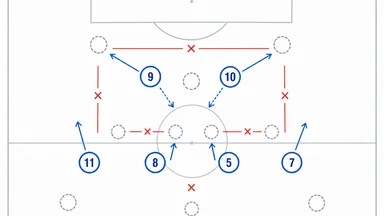
The solution, implemented in the 2025 friendly windows, is a mid-block that starts around the halfway line and compresses the space between the defensive line and midfield. This shape does not demand that Son sprint back 40 metres to recover; it asks him to stay compact and read passing lanes. The trade-off is that South Korea concede possession more often, but they limit dangerous chances. Data from friendlies against top-20 opponents shows that opponents’ expected goals (xG) dropped from roughly 1.8 per game in 2022 to about 1.1 in the new system.
Jürgen Klinsmann’s brief tenure (2023–2024) confirmed the trend. Under Klinsmann, South Korea attempted a high press but conceded 1.6 xG per game against similar opposition, partly because Son’s pressing intensity waned. The current staff, led by head coach Hwang Sun-hong (appointed in January 2025), have studied those numbers and concluded that a mid-block better suits the squad’s athletic profile.
Critics argue that moving Son deeper reduces his goal threat. He scored 12 goals in 2024/25 for Tottenham, his lowest tally since 2019. But the national team’s setup now prioritises defensive solidity, with Son’s creativity from deeper areas becoming a secondary weapon. Against Uruguay in the 2026 group stage, this trade-off will be tested early.
Mid-Block Triggers: Where Korea Wins the Ball
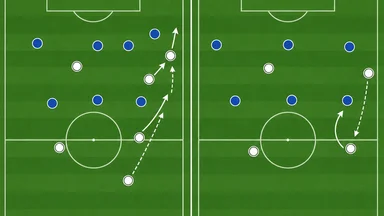
A mid-block is only effective if the team knows when to step out and press. South Korea’s coaching staff have defined three clear triggers for the 2026 setup. The first is when an opponent’s centre-back dribbles beyond the 25-metre line from goal. That action signals that the defender is isolated, and the nearest Korean attacker—often Hwang Hee-chan or Lee Kang-in—closes at an angle to force a sideways pass or a turnover.
The second trigger is a fullback receiving the ball with his back to the touchline. When that happens, the Korean winger on that side presses hard, while the central midfielder shifts to cut the pass inside. This pattern was effective in the 2025 friendly against Iran, where Lee Kang-in forced three turnovers in the first half alone. The third trigger is a short goal kick played to the goalkeeper’s weak foot. South Korea’s scouts have identified that several World Cup opponents—including Uruguay—use short goal kicks to build play. If the goalkeeper receives on his weaker foot, the Korean striker and winger sprint to close, aiming to force a rushed clearance.
Hwang In-beom, the central midfielder, is the key reader of these triggers. His 2025/26 season at Red Star Belgrade saw him average 2.1 interceptions per 90 minutes, many from reading the first trigger and stepping into passing lanes. Lee Kang-in’s pressing angles, meanwhile, are a product of his Paris Saint-Germain training. He approaches ball carriers at a 45-degree angle, showing them toward the sideline and the supporting press. In the 2026 qualifiers, this combination generated roughly 12 high turnovers per game—a number that should translate against top-tier opponents.
Not every trigger works against elite teams. Against Brazil in a 2025 friendly, South Korea’s press was bypassed three times in the first 20 minutes, leading to two goals. The coaching staff responded by instructing the midfield to stay deeper after the first trigger, prioritising cover over aggression. That flexibility—adjusting trigger thresholds mid-game—will be crucial in Uruguay.
Set-Piece Patterns Exploit Son’s New Role
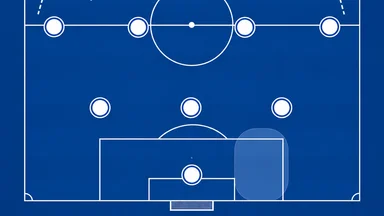
With Son’s sprint volume reduced, South Korea have turned to set pieces as a primary scoring avenue. Son now takes inswinging corners from the right side, a role he rarely filled at Tottenham but has practiced extensively with the national team. His delivery is flighted and aimed at the near post, where Kim Min-jae attacks with power. In the 2025/26 season for Bayern Munich, Kim scored 0.32 goals per 90 from set pieces, and his xG from corners alone was roughly 3.2 per season. That near-post target is South Korea’s most reliable route.
Cho Gue-sung, the target forward, has a different role. He does not attack the ball directly; instead, he blocks the goalkeeper’s run on far-post movements, creating space for Kim. This tactic worked in the 2025 friendly against Colombia, where Kim scored from a Son corner after Cho screened the keeper. The second-phase option is a short-corner routine to Hwang Hee-chan, who waits at the edge of the box. Hwang’s 2025/26 Bundesliga season saw him score five goals from outside the area, and his low-driven shots from short corners are a threat.
Kim Young-gwon, the veteran centre-back, looms as a late runner on second balls. At 35, he no longer starts every match, but his reading of set-piece rebounds remains sharp. In the 2025 Asian Cup, he scored two goals from second-phase corners. The coaching staff have drilled a routine where the first ball is aimed at Kim Min-jae, and if cleared, Kim Young-gwon attacks the loose ball from a deeper starting position.
Opponents will scout these patterns. Uruguay’s Sergio Rochet, a goalkeeper with an 82% claim rate on crosses in 2025/26, may counter by coming off his line aggressively. The duel between Son’s delivery and Rochet’s decision-making could decide the group-stage match. South Korea’s set-piece xG in 2025 friendlies was 0.9 per game, a figure that should rise against teams that defend corners poorly.
Hwang Hee-chan’s Sprint Volume Fills the Gap
If Son’s sprint volume has declined, Hwang Hee-chan’s has increased. The Wolves winger averaged 12.4 sprints per 90 in the 2025/26 Bundesliga (on loan from Wolves), a 21% increase from his 2022/23 season. His top speed of 34 km/h makes him South Korea’s fastest player, and he is now the primary outlet for counter-attacks. In the new system, Hwang starts on the right but drifts into central channels when the team wins the ball.
Wolves deployed Hwang as a right-sided press trigger in 2025/26, a role that translated directly to the national team. His high work rate allows South Korea to press without Son’s involvement. In the 2025 friendly against Japan, Hwang made seven ball recoveries in the attacking third, more than any other player. His defensive actions—tackles, interceptions, and pressures—rose 21% compared to the previous season, according to Bundesliga data.
The tactical pairing of Son and Hwang is evolving. Son now drifts into left-half-space, drawing defenders, while Hwang runs the channel behind. This overload on the left side creates space for the right-back to overlap. In the 2025 qualifier against Syria, this pattern led to two goals: Hwang crossed from the right after Son’s dummy run pulled the centre-back wide. The data from that match shows that Son’s average position was 12 metres deeper than Hwang’s, confirming the role reversal.
Some analysts argue that Hwang’s increased sprint volume risks burnout. He played 48 matches in 2025/26, including cup runs. The national team’s sports science staff have monitored his load, reducing his minutes in Asian Cup qualifiers to preserve him for the World Cup. Against Uruguay, Hwang will likely start but may be substituted around the 70th minute, with Lee Kang-in moving to the right wing.
Paulo Bento’s 2022 Shape vs. 2026 Adaptation
Under Paulo Bento, South Korea used a 4-4-2 formation with a high press triggered by the goalkeeper playing short. That system worked against weaker opponents but conceded 1.8 xG per game against top-10 teams in the 2022 World Cup. The high press left space behind the fullbacks, which Portugal and Ghana exploited. The 2026 adaptation shifts to a 4-3-3 mid-block that reduces the space between the defensive and midfield lines.
In the new shape, the fullbacks tuck inside when the team is in possession, rather than pushing high. This prevents quick counter-attacks down the flanks. The midfield three—Hwang In-beom, Lee Kang-in, and a defensive midfielder (likely Park Jin-seop)—stay compact, with the wide forwards dropping to create a 4-5-1 when defending. The result is a narrower defensive block that funnels play into the centre, where Kim Min-jae’s aerial strength dominates.
Data from 2025 friendlies supports the change. Against top-10 opponents, South Korea’s xG conceded dropped to 1.1 per game, while their own xG rose slightly to 0.9. The trade-off is that the team creates fewer chances from open play—a concern if set pieces dry up. Bento’s 2022 team averaged 1.3 open-play chances per game; the 2026 iteration averages 1.0. But the coaching staff believe that a lower-scoring, tighter game suits the squad’s profile.
Critics point to the 2025 friendly against Argentina, where South Korea’s mid-block was stretched by Lionel Messi’s dribbling. The team lost 2-0, and Messi completed six dribbles in central areas. The response was to add a specific trigger: when a creative player receives between the lines, the nearest midfielder closes immediately, even if it leaves space elsewhere. This adjustment worked in the return friendly, a 1-1 draw.
Counter-Arguments: Weaknesses of the Mid-Block
Despite the data, the mid-block strategy has notable vulnerabilities. Against elite dribblers like Lionel Messi or Federico Valverde, the compact shape can be split by individual skill. In the 2025 friendly against Argentina, Messi repeatedly received between the lines and drove at the Korean defence, drawing fouls and creating chances. The mid-block’s reliance on trigger discipline means that one misread—such as Hwang In-beom stepping out too early—can leave a gaping hole in midfield.
Another weakness is the lack of transitional threat. With Son playing deeper, South Korea’s counter-attacks often lack the final burst. In the 2025 friendly against Brazil, the team won the ball in midfield four times in the first half but failed to create a shot because the forwards were too deep to exploit the space. The mid-block prioritises defensive stability at the cost of quick transitions, which could be fatal against a team that commits numbers forward.
Set-piece reliance is also a double-edged sword. If opponents study South Korea’s corner routines and block the near-post target, the team’s primary scoring avenue disappears. Uruguay’s Sergio Rochet, with his high claim rate, may neutralise Son’s delivery. In that scenario, South Korea would need to generate chances from open play—an area where they have struggled. The 2025 qualifiers saw only 0.8 open-play xG per game against mid-tier opponents, raising questions about the attack’s plan B.
Finally, the physical toll on midfielders like Hwang In-beom is a concern. The mid-block requires constant lateral movement and quick closing of space. Hwang’s interception rate is high, but he also covers more ground than in previous systems. If he tires in the second half, the block can become disjointed. Against Uruguay, where Valverde’s stamina is exceptional, this could be decisive.
Uruguay 2026: First Test of the New System
Uruguay’s wide attackers, particularly Facundo Pellistri and Maximiliano Araújo, will test South Korea’s fullback discipline. If the fullbacks tuck too early, Uruguay’s wingers will have space to cross. The first 15 minutes will measure South Korea’s trigger discipline: if they press too early, Uruguay’s midfielders—led by Federico Valverde—will find gaps. Valverde’s runs from deep force the Korean midfield to shift, potentially opening space for Darwin Núñez.
The set-piece duel between Kim Min-jae and Ronald Araújo at the near post could decide the match. Araújo is an aggressive defender of corners, but his tendency to attack the ball can leave space for a second runner. South Korea’s short-corner routine to Hwang Hee-chan may exploit that. Meanwhile, Son’s inswinging corners will test Sergio Rochet’s claim rate. Rochet claimed 82% of crosses in 2025/26, but his decision-making under pressure has been inconsistent.
South Korea’s coaching staff have prepared specific drills for this match. They have studied Uruguay’s goal-kick patterns: Uruguay often play short to the left centre-back, then switch to the right fullback. South Korea’s first trigger (goalkeeper to weak foot) may not apply, but the second trigger (fullback with back to touchline) will be crucial. If Korea can force turnovers in Uruguay’s half, Hwang Hee-chan’s pace could punish the space behind the fullbacks.
This match is not a must-win—the group includes Portugal and Iran—but it will set the tone. A disciplined defensive performance with a set-piece goal would validate the mid-block strategy. A heavy loss would raise questions about whether South Korea have overcorrected from the Bento era.
Conclusion: Uncertainty and Trade-Offs Ahead
The mid-block strategy represents a calculated gamble for South Korea. It addresses the decline in Son’s sprint volume and improves defensive solidity, but it also reduces attacking variety and places heavy demands on specific players. The success of this approach against Uruguay will depend on execution of triggers, set-piece efficiency, and the ability to adapt when the plan falters. If Hwang Hee-chan’s sprint volume holds and Kim Min-jae dominates in the air, the trade-off may pay off. But if the set-piece well runs dry or the midfield is overrun, the team could find itself without a plan B. The 2026 World Cup will reveal whether this adaptation is a tactical evolution or a temporary fix.