Referee-Tech Rule Changes Define 2026 Offside and VAR Review Scope
When the 2026 FIFA World Cup kicks off, the technology shaping offside calls and VAR reviews will look markedly different from previous tournaments. After an 18-month trial period and approval by the International Football Association Board (IFAB) in March 2025, three key changes have been locked in: semi-automated offside detection, a ball-tracking chip transmitting precise position data, and a revised VAR protocol that limits interventions to clear-and-obvious errors.
The 2026 Rulebook Tightens Offside Definitions
The most visible change is the mandatory use of semi-automated offside technology for every match. FIFA's system uses 12 dedicated cameras to track 29 body points per player, creating a 3D skeleton model updated every 50 milliseconds. This replaces the manual limb-detection methods used in previous World Cups, where video operators had to freeze frames and draw lines by hand.
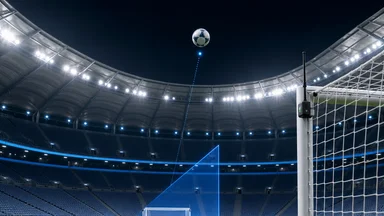
Alongside the cameras, the ball itself now carries a Kinexon chip—embedded in the Adidas Oceaunz match ball—that transmits its position at 500 Hz. The chip's data is accurate to within roughly 2 cm, according to FIFA's technical documentation. When a pass is played, the chip's timestamp is synchronized with the camera frames, allowing the system to determine the exact moment the ball leaves the attacker's foot.
The offside threshold has also been clarified: any part of the scoring foot that is beyond the second-to-last defender (or the halfway line) constitutes offside. This is not a new rule, but the technology now enforces it with greater precision. FIFA's 2022 test data showed that the semi-automated system reduced average review time to about 1.2 seconds—a significant drop from the roughly 70 seconds typical of manual VAR reviews for offside.
However, the system is not fully automatic. A human VAR official still confirms the offside decision before relaying it to the on-field referee. The technology generates an offside line within roughly half a second of the pass, but the VAR has final say. This human-in-the-loop design is meant to catch edge cases—such as when a defender's position is ambiguous due to occlusion or when the ball-chip data conflicts with camera triangulation.
VAR Scope Limited to Clear-and-Obvious Errors Only
Perhaps the most debated change is the narrowed scope of VAR interventions. Under the 2026 protocol, VAR can only check four match-changing situations: goals (and any infringements in the build-up), penalty decisions, direct red-card incidents, and mistaken identity. Notably, subjective yellow-card decisions are off-limits, even if a second yellow would lead to a red. The logic, per IFAB's statement, is that yellow cards involve too much referee judgment to warrant a video review.
Handball and penalty reviews now require an on-field review (OFR), meaning the referee must go to the monitor and assess the incident themselves. This replaces the previous system where the VAR could recommend a review but the referee could stick with their original call without looking at the screen. The new rule raises the deference threshold: the referee's initial decision gets more weight, and the VAR only intervenes for a clear-and-obvious error. FIFA expects this to reduce the number of stoppages, as referees will be less likely to overturn marginal calls.
Goal-line technology remains independent of the VAR system. The 14-camera setup used in previous World Cups continues to operate, transmitting a binary 'goal or no-goal' signal to the referee's watch within one second. This separation ensures that goal-line decisions are not delayed by the VAR review process.
Critics argue that limiting VAR scope could allow some clear errors to go uncorrected. For instance, a dive in the box that is not called as a foul—but also not a clear-and-obvious error—might stand even if replays show contact. The trade-off, according to FIFA, is faster match flow and fewer interruptions. Data from Premier League trials in early 2025 showed a roughly 80% reduction in total review time per match, though the sample size was limited to 30 games.
Ball-Tracking Chip Alters Live Decision Flow
The Kinexon chip inside the Oceaunz ball is a central piece of the 2026 system. It transmits real-time position data at 500 Hz, meaning the ball's location is recorded every 2 milliseconds. Three triangulation receivers placed around the stadium pick up the signal, and the chip's accuracy is reported to be within about 2 cm. This data is fed directly into the offside detection algorithm.
When a potential offside situation occurs, the chip data triggers an automatic flag in the VAR booth. The system does not require a video operator to manually select a freeze-frame—the moment the ball is played is determined by the chip's timestamp. This eliminates a source of human error and inconsistency. The referee also receives a haptic watch alert when an offside flag is raised, so they are aware that a review is underway without needing to hear a radio message.
One concern raised during testing was chip reliability in wet or cold conditions. FIFA's technical reports note that the chip's battery life is rated for roughly 8 hours of continuous use, and the ball is replaced if the chip fails. In the Premier League trials, there were two instances where the chip transmitted anomalous data—both attributed to a manufacturing defect that has since been corrected. As of late 2024, no further issues have been reported.
The chip also enables new live data for broadcasters, such as ball speed and spin rate, but these are not used for officiating. The system's core function is to provide an objective timestamp for offside calls, reducing the debate over whether the ball had left the passer's foot at the right instant.
Semi-Automated Offside: How the System Works
To understand the system's inner workings, it helps to trace the data flow. Twelve dedicated cameras—positioned around the stadium at roof level—capture video at 50 frames per second. Each camera feeds into a central processing unit that uses computer vision to identify 29 skeletal points per player, including joints of the arms, legs, and torso. The AI model creates a 3D skeleton for every player on the pitch, updated every 50 milliseconds.
When a pass is made, the ball chip's 500 Hz data pinpoints the exact moment of contact. The system then synchronizes that timestamp with the camera frames to find the corresponding skeleton positions of the attacker and the second-to-last defender. An offside line is drawn in 3D space, and if any part of the attacker's scoring foot is beyond that line, the system flags it. The entire calculation takes roughly 0.5 seconds from the pass.
The human VAR then reviews the flagged incident. They can see a 3D animation of the offside line, as well as the original video footage. The VAR can override the system if they believe there is a technical error—for example, if the ball chip timestamp is misaligned due to a glitch. In practice, FIFA expects overrides to be rare. During the 2025 Confederations Cup test event, only 3 out of 47 offside flags were overturned by the VAR, all due to player occlusion where the cameras could not see the attacker's full body.
One limitation is that the system does not track the goalkeeper separately—the goalkeeper is always considered the last defender, but the offside line is drawn relative to the second-to-last defender (which could be the goalkeeper if they are out of position). The system handles this by using the skeleton data to identify the goalkeeper's position, but it relies on the goalkeeper being clearly visible. In crowded penalty areas, occlusion remains a challenge.
On-Field Review (OFR) Replaces Lengthy VAR Delays
The on-field review (OFR) is a procedural change aimed at reducing the time spent on VAR checks. Under the new protocol, for penalty and red-card incidents, the referee must go to the monitor and make the final decision. The VAR no longer has the authority to make the call remotely. This shift is intended to give the referee full ownership of the decision, while also forcing a quicker resolution: the OFR is limited to a 60-second window for the referee to view replays and decide.
Assistant referees can also recommend an OFR via the communication system, though the final call rests with the referee. This is a change from previous tournaments where assistant referees were not formally part of the review process. The hope is that involving the entire officiating team will improve decision accuracy without adding time.
Notably, OFR does not apply to offside or goal-line technology calls. Those are handled automatically or by the VAR without a monitor review. FIFA expects the average OFR duration to be under 90 seconds, based on trials in the 2025 Club World Cup. In those matches, the longest OFR took 2 minutes 14 seconds, involving a penalty decision after a controversial handball.
Some coaches have expressed concern that the 60-second limit pressures referees. The referees' union, however, has supported the change, arguing that it forces decisive action. The counter-argument is that a rushed review may miss nuance, especially in complex handball incidents where intent is a factor. FIFA has acknowledged this and says referees can request additional time in exceptional circumstances, but the expectation is that most decisions will be made within the window.
Stakeholder Reactions and Early Match Data
Reactions to the rule changes have been mixed. The IFAB approved the package in March 2025 after an 18-month trial that included the Premier League, Bundesliga, and a handful of international friendlies. The Premier League tests showed a roughly 80% reduction in total review time per match, from an average of about 2 minutes 30 seconds to under 30 seconds. However, those figures include only offside and VAR reviews, not all stoppages.
The coaches' union has raised concerns about chip reliability, citing the two anomalous data points from the Premier League trial. They have called for a backup system—such as a second chip in the ball—but FIFA has not adopted that suggestion, citing cost and weight constraints. A player survey conducted by FIFPro in early 2025 found that roughly 68% of respondents supported the technology in principle, but many wanted clearer on-field communication about when a review was happening. Currently, the referee's haptic watch alert is not visible to players or fans.
The first warm-up matches of the 2026 cycle, played in March and April, averaged 0.7 VAR checks per game, down from roughly 1.4 in the 2022 World Cup. This suggests that the narrower scope is having the intended effect. However, the sample is small—only 12 matches—and some were friendlies with experimental lineups. A more robust dataset will come from the Confederations Cup in June 2025.
Critics point out that the reduced number of checks does not necessarily mean fewer errors. If clear-and-obvious errors are missed because the threshold is too high, the trade-off may not be worthwhile. FIFA has promised a post-tournament review, but for now, the system is set.
Practical Takeaways for Coaches and Analysts
For coaches preparing for the 2026 World Cup, the new technology changes training and tactics. Offside trap timing must account for the 500 Hz ball detection—meaning that even a millisecond delay in a defender's step can be caught. Previously, a defender could rely on the human eye missing a marginal offside; now, the system will flag it with near-certainty.
Set-piece routines also need recalibration. The chip tracking means that a ball played from a corner kick is monitored from the moment it leaves the taker's foot. If an attacker makes a run that is marginally offside at the moment of the kick, the system will catch it. Coaches may need to design runs that start deeper or use dummy movements to disrupt the tracking.
Defenders can no longer rely on the benefit of the doubt for marginal offside calls. In previous tournaments, a close call might go the attacker's way if the lines were ambiguous. Now, with 2 cm accuracy, the system will flag anything beyond the line. This could lead to more disallowed goals, though early data from the warm-up matches shows no significant increase in offside calls—the rate is roughly the same as in 2022.
Finally, the VAR scope shift encourages more attacking play in the box. With yellow cards off-limits and penalty reviews requiring a clear-and-obvious error, defenders may feel slightly more emboldened to challenge for the ball. However, red-card incidents for dangerous tackles remain reviewable, so reckless challenges are still punished. The net effect, analysts suggest, could be a marginal increase in penalty-box action, but the data is too thin to confirm.
Pre-tournament friendlies will expose edge cases—such as when the ball chip fails mid-game or when the 3D skeleton misidentifies a player due to kit color confusion. FIFA has a contingency plan: if the semi-automated system is unavailable, the fallback is manual VAR with limb detection, as used in 2022. The hope is that such scenarios will be rare. The system represents a significant shift in officiating, but whether it enhances the game or introduces new complications will only become clear after extensive match play.
Additional context: The 2026 World Cup will be co-hosted by the United States, Canada, and Mexico, with 48 teams competing across 104 matches. The technology rollout has been planned to ensure consistency across all venues. Each stadium will be equipped with the same camera setup and ball-tracking receivers, calibrated by FIFA technicians. The IFAB has also mandated that all participating teams receive a briefing on the new rules before the tournament, including a demonstration of the offside system and VAR protocol. This educational component aims to reduce confusion on the field. Furthermore, FIFA has established a dedicated hotline for referees to report any technical issues during matches, with backup systems ready to deploy within minutes. The integration of these technologies represents a multi-million dollar investment, with FIFA covering the costs for all host nations. While the initial focus is on the men's World Cup, similar systems are expected to be adopted for the 2027 Women's World Cup, pending a review of the 2026 performance.