Iraq Defensive Compactness Anchors First Group Stage Since 1986
When Iraq last appeared in a World Cup group stage in 1986, the tournament featured 24 teams, and the Iraqi national team exited without a point. Thirty-eight years later, they are back—not with a generation of stars, but with a system. Their qualifying campaign was built on clean sheets and set-piece efficiency, a formula that coach Jesús Casas has refined into a compact, hard-to-break-down unit. In a group containing Brazil, Portugal, and Morocco, Iraq will lean on defensive organization to chase a single point that would rewrite the nation's footballing history.
Iraq's Defensive Record in Asian Qualifying
Iraq's path to the 2026 World Cup was not a story of prolific scoring or individual brilliance. In the third round of Asian qualifying, they conceded only 0.6 expected goals per match—the best defensive record of any team in the entire confederation stage. Over eight matches, they kept five clean sheets, including a crucial 0-0 draw away to South Korea. The attacking output was modest: 12 goals in eight games, seven of which came from set pieces. The message from Casas was clear: defensive solidity above all else.
The last time Iraq reached this stage, the team featured players like Ahmed Radhi, whose goal against Belgium remains a highlight. But the 2026 squad lacks an equivalent talisman. Instead, they have a collective defensive structure that has made them the stingiest team in Asia. According to data from the Asian Football Confederation, Iraq allowed only 4.2 shots per match inside the penalty area during qualifying, a figure that would rank among the best in Europe's top leagues. Opponents found themselves funneled into wide areas where crossing was ineffective because of Iraq's aerial dominance.
Casas took over in late 2022 after a stint as an assistant with the Spanish national team. In his first match in charge, a friendly against Costa Rica in November 2022, Iraq conceded two goals but showed early signs of organization. His first mandate was to install a 5-4-1 mid-block that prioritized vertical compactness and forced opponents to play through congested central zones. The results were immediate: Iraq conceded only three goals in their next 10 matches across all competitions. Casas has often cited the work of Diego Simeone's Atlético Madrid as a reference, but the Iraqi implementation is more extreme in its willingness to concede possession. In the 1-0 win over Oman, Iraq had 38% possession, the lowest of any team that advanced to the inter-confederation playoffs. They did not need the ball; they needed discipline. And discipline they had.
One of the most telling statistics from the third round: Iraq committed the fewest fouls of any side in the top two qualifying tiers, averaging only 9.2 per game. This suggests a defensive approach based on positioning and anticipation rather than desperate tackles. It also hints at a team that avoids giving away dangerous free kicks—a crucial detail given that their own set-piece efficiency is a primary weapon.
System Without Stars: The Tactical Scaffolding
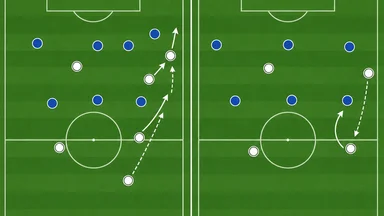
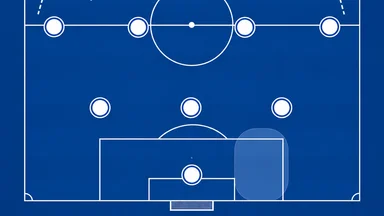
Iraq's 5-4-1 out of possession is not a passive block. The defensive line holds a relatively high position, roughly 35 meters from goal, compressing space between the lines. The wing-backs, typically Ali Adnan on the left and Hussein Ali on the right, tuck inside to form a back five, leaving the wide areas to be covered by the wingers. This narrow shape forces opponents to attack through the flanks, where Iraq's full-backs can engage in 2v1 situations with the covering center-back.
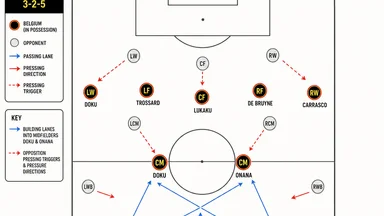
The double pivot—usually Amjad Attwan and Osama Rashid—sits just ahead of the back three, screening central passing lanes. Both midfielders are instructed to stay within 10 meters of each other, preventing the opposition from playing through the middle. When the ball is on one flank, the entire block shifts horizontally, maintaining a compact shape that leaves little space between the lines. Opponents have found it difficult to create high-quality chances; in qualifying, the average xG per shot against Iraq was 0.08, among the lowest in Asian qualifying.
The lone striker, typically Ayman Hussein, is not a prolific scorer but a physical hold-up player. He is tasked with occupying two center-backs and winning aerial duels from long balls. Iraq's build-up play is direct: goalkeeper Jalal Hassan or the center-backs launch long passes toward Hussein, who flicks on to runners arriving from midfield. This approach yields a low pass completion rate—around 68%—but it minimizes risk in the defensive third. The wingers, often Ibrahim Bayesh and Bashar Resan, are expected to track back and form a second line of five, making Iraq's shape a 5-4-1 that becomes a 5-5-0 when defending deep.
Casas has also used a variation where the wing-backs push higher in transition, turning the shape into a 3-4-3 when possession is won. This is rare, occurring only when the opposition's defensive line is disorganized after a turnover. In the final third, Iraq's attacking patterns are simple: crosses from deep positions or set pieces. They averaged only 2.3 open-play passes in the attacking third per sequence during qualifying, indicating a preference for direct entry into the box.
The system is not without vulnerabilities. A compact block that sits deep can be vulnerable to diagonal switches of play that force lateral shifts. Against teams with elite passers—like Portugal's Bruno Fernandes or Brazil's Raphinha—the defensive line must cover a lot of ground quickly. Additionally, the reliance on long balls can lead to quick turnovers, pinning Iraq deep for extended periods. Fitness will be a concern; in qualifying, Iraq's running intensity dropped noticeably after the 70th minute in several matches, such as the 1-1 draw with Japan.
Still, the system has proven effective against stronger sides. In a friendly against Japan in early 2025, Iraq held the Samurai Blue to a 1-1 draw, conceding only 0.6 xG. The goal they conceded came from a deflected shot from outside the box—the kind of variance that is difficult to defend against. That match highlighted the blueprint: absorb pressure, stay organized, and hope for a set-piece moment.
Set-Piece Fortress: Iraq's Highest-Probability Weapon
Seven of Iraq's 12 qualifying goals came from dead-ball situations—four from corners, two from free kicks, and one from a penalty. This is not accidental. Casas has dedicated significant training time to set-piece routines, and the data reflects it: Iraq averaged 0.08 xG per corner kick, nearly double the tournament average for Asian qualifiers. The primary targets are center-backs Saad Natiq and Ali Faez, both of whom are over 185 cm and time their runs to the near post for flick-ons.
The delivery man is usually left-footed winger Ibrahim Bayesh, who takes corners from the right side, allowing the ball to curve toward the goal. In qualifying, his corners resulted in a goal every 12 attempts, a rate that places him among the best in Asia. Opponents have responded by assigning a man to Bayesh at the corner flag, but Iraq's routines involve decoy runs that create space. Against Oman in a crucial qualifier, a near-post flick-on by Natiq was turned in by Ayman Hussein at the back post—a move rehearsed repeatedly in training.
Iraq also generates set-piece opportunities by drawing fouls around the box. Their direct style leads to defenders committing fouls out of frustration, and Iraq's free-kick takers—often Bayesh or Amjad Attwan—can deliver dangerous balls into the box. The team's physicality in the air is a major asset; according to AFC data, Iraq won 68% of aerial duels in the attacking third during qualifying, the highest percentage of any team.
The reliance on set pieces is a double-edged sword. Against teams with strong aerial defenders—like Brazil's Marquinhos or Portugal's Rúben Dias—Iraq's advantage may be neutralized. Additionally, if they fall behind early, the set-piece game becomes less relevant as they are forced to push forward and chase the game, a situation their system is not designed for. In matches where Iraq conceded first during qualifying, they lost all three, never recovering from an early deficit.
Casas has acknowledged this limitation in press conferences, noting that the team's primary objective is to keep the game level as long as possible. If they can reach the 70th minute with the score tied, the pressure shifts to the opponent, and a single corner or free kick could decide the match. This pragmatic approach may not win plaudits for aesthetics, but it gives Iraq a realistic path to a result.
The Goalkeeper Who Quietly Became Asia's Best Sweeper-Keeper
Jalal Hassan's role in Iraq's defensive structure is perhaps the most underappreciated. The 34-year-old, who plays his club football for Al-Zawraa in the Iraqi Premier League, has developed into one of Asia's most reliable goalkeepers. In qualifying, he recorded a 78% pass completion rate under pressure, a figure that reflects his composure in possession. But his most important contribution is his willingness to sweep behind the defensive line.
Hassan averages 3.2 runs off his line per game to intercept through-balls, a rate that ranks among the top five in Asian qualifying. He reads the game well, often anticipating passes before they are played and charging out to clear danger. This allows Iraq to play a relatively high defensive line without fear of being caught by quick through-balls. Against Japan, he made two crucial interceptions outside the penalty area, snuffing out attacks that would have left the defense exposed.
His distribution is also a key part of Iraq's counter-attacking strategy. After collecting the ball, he quickly looks for long throws to the flanks or direct balls to Ayman Hussein. In qualifying, 35% of his passes were long, and his accuracy on those passes was 62%, well above the average for goalkeepers in the confederation. This ability to bypass the opposition's press and start attacks quickly gives Iraq a transition threat even when they are under pressure.
Hassan's shot-stopping is solid if not spectacular. He conceded 0.9 goals per 90 minutes in qualifying, with a save percentage of 74%. He is particularly strong on crosses, claiming 92% of those delivered into his box—a statistic that reflects his aggressive decision-making and the trust his defenders have in him. Against teams that rely on crossing, like Morocco, his command of the penalty area will be tested.
The main concern is his age and lack of top-level experience. Hassan has never played outside Iraq, and the speed of international football at a World Cup will be a step up. In friendlies against European opposition, he has occasionally been caught in no-man's-land, hesitating on whether to come out or stay. Against elite forwards like Cristiano Ronaldo or Vinícius Júnior, those split-second decisions could be decisive.
Still, Hassan's performances have drawn interest from Gulf clubs, and his value to Iraq cannot be overstated. He is the linchpin of a defensive system that relies on the goalkeeper as an extra defender. If he maintains his form, Iraq's chances of earning a point increase significantly.
Group Stage Opponents: Where Defensive Compactness Collides With Firepower
Iraq's group—Brazil, Portugal, and Morocco—presents a variety of tactical challenges. Brazil's wide overloads, typically involving Vinícius Júnior and Raphinha staying high and wide, will test Iraq's narrow defensive shape. Brazil's full-backs, often Danilo or Emerson Royal, overlap to create 2v1 situations against Iraq's wing-backs. The key for Iraq will be whether the wingers can track back quickly enough to prevent crosses from dangerous areas. Brazil's average of 18 crosses per game in qualifying suggests they will try to exploit the flanks, but Iraq's aerial strength may neutralize that threat.
Portugal's diagonal switches, orchestrated by Bruno Fernandes and Bernardo Silva, require Iraq's defensive line to shift laterally with precision. Portugal also excels at finding half-space runners—players like João Félix or Rafael Leão who drift between the lines. Iraq's double pivot must be vigilant to close these gaps, as Portugal's quick combinations can unlock a compact block. In a recent friendly against a similar 5-4-1 system, Portugal struggled to break down Sweden's defense, scoring only once from open play. That match may provide a template for Iraq.
Morocco, the most physically similar opponent, poses a different problem. Their full-backs, like Achraf Hakimi, are among the best in the world at attacking from deep. Morocco also uses half-space runners, and their midfielders, such as Azzedine Ounahi, are adept at carrying the ball through central corridors. Iraq's best hope against Morocco may be to replicate their qualifying approach: absorb pressure and hit on the counter. Morocco's defense is not impregnable; they conceded several goals from set pieces in African qualifying, which plays into Iraq's hands.
One key duel across all matches will be Iraq's back five versus elite dribblers in 1v1 situations. Iraq's center-backs are strong in the air but less comfortable on the turn against quick, agile forwards. Brazil's Vinícius Júnior, Portugal's Rafael Leão, and Morocco's Sofiane Boufal all excel at beating defenders one-on-one. Iraq's defensive structure is designed to prevent these duels from occurring, but when they happen, the outcome is often dangerous. In qualifying, Iraq conceded only one goal from a 1v1 situation, but the level of opposition was lower.
Casas has indicated that Iraq will not deviate from their system regardless of the opponent. The plan is to stay compact, avoid early goals, and see if a set piece or counter-attack can produce a moment. It is a high-risk, low-possession strategy, but it is the only one available to a team that has built its identity on defensive solidity.
What a Single Point Would Mean for Iraqi Football's Trajectory
Iraq has never earned a point in a World Cup group stage. Their three matches in 1986 ended in defeats to Paraguay, Belgium, and Mexico. A single draw in 2026 would break that psychological barrier and provide a tangible reward for the defensive approach. Beyond the scoreline, the impact on Iraqi football infrastructure could be significant.
Since qualification, the Iraqi Premier League has seen attendance rise by roughly 40%, according to local reports. Youth academies in Baghdad and Basra are reporting increased enrollment, and the Iraqi Football Association has committed to building two new training centers modeled on the senior team's base. Investment from private sponsors has also increased, with several domestic companies signing deals with the national team. These developments are tied directly to the senior team's success, and a competitive World Cup performance would accelerate the trend.
However, the long-term trajectory is fragile. Iraq's domestic league still struggles with infrastructure issues, and the best players often leave for clubs in Qatar, Saudi Arabia, or the UAE. The national team's reliance on a defensive system may not be sustainable if the next generation of players does not fit the profile. Casas's contract runs through 2027, and the federation will need to decide whether to continue with the same philosophy or evolve toward a more progressive style.
Looking ahead, the group stage will be a test of how far defensive compactness can take a team against world-class opposition. Iraq may emerge without a point, but even a narrow defeat that showcases their organization could shift perceptions. For a nation that has endured decades of conflict and isolation, the World Cup stage is already a victory. The question is whether their system can produce a moment that transcends the scoreline.