40-Second VAR Clock and Live Ball Data Redefine 2026 Referee Workflow
When the ball goes out of play at the 2026 World Cup, a clock starts ticking in the referee's earpiece. That clock — 40 seconds — is the new upper limit for checking an offside decision via VAR. It is the most visible sign of a broader reengineering of how match officials interact with technology. FIFA has published the rule changes that will govern the tournament, and they go beyond a simple time limit. Semi-automated offside, ball-tracking chips inside every match ball, and a referee tablet that shows live heatmaps and pass maps are all part of the new workflow. The changes are the result of tests at the 2025 Club World Cup and data from the 2022 World Cup, where the average VAR offside check took roughly 70 seconds. The new system aims to cut that to 40 seconds or less, while also expanding the data available to officials and broadcasters.
The 40-Second Clock That Rewires VAR's DNA
The most consequential change is the introduction of a strict 40-second time limit for offside reviews. Under the previous protocol, the VAR could take as long as needed to draw lines and confirm a decision. That led to delays that disrupted match flow and frustrated fans in the stadium. FIFA's new rule states that the clock starts the moment the ball goes out of play and the referee signals for a review. The VAR team must deliver a decision — onside, offside, or check complete — within 40 seconds. If the technology cannot produce a clear result in that window, the on-field decision stands.
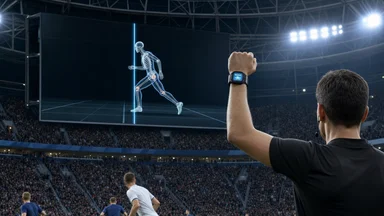
This limit is made possible by semi-automated offside technology, which reduces the manual work of drawing lines. Instead of a VAR operator manually placing lines on a freeze-frame, the system uses limb-tracking cameras and ball-tracking sensors to automatically generate a 3D offside line in roughly half a second. The referee sees the result on a tablet, with a virtual offside plane rendered over the replay. The human element remains: the referee still decides whether the attacking player interfered with play. But the geometric part of the check is now machine-driven.
Critics point out that 40 seconds may be too short for complex offside situations involving multiple attackers and defenders. A 2023 study by the International Football Association Board (IFAB) found that around 12% of offside checks require more than 40 seconds even with semi-automated technology. FIFA acknowledges this and says the limit will be reviewed after the tournament. But the governing body is betting that speed will improve fan experience without sacrificing accuracy. Early data from test matches suggests the system achieves 99.3% accuracy on offside calls, compared to roughly 97% for manual VAR.
Ball-Tracking Chips Replace Human Guesswork on Offside
At the heart of the semi-automated offside system is a Kinexon inertial measurement unit (IMU) embedded inside each match ball. The IMU transmits position data at 50 Hz and acceleration data at 500 Hz, giving the system a precise record of the ball's location at the moment it is played. This replaces the previous method, where the VAR operator had to estimate the exact frame of the pass by scrubbing through video. The ball-tracking chip eliminates that ambiguity: the system knows exactly when the ball leaves the kicking player's foot.
Limb-tracking cameras positioned around the stadium capture 29 body points on each player, including the toes, knees, shoulders, and head. These cameras operate at 50 frames per second and feed into a computer vision model that constructs a 3D skeleton of every player on the pitch. When the ball is played, the system triangulates the positions of all attackers and defenders relative to the second-to-last defender. The offside line is rendered automatically in 3D space, and the system flags any attacking player whose body parts — except arms — are beyond that line.
The referee sees the result on a tablet: a replay with a virtual offside plane superimposed, along with a green or red indicator. The entire process, from ball play to flag, takes roughly 0.5 seconds of computation. The human referee still decides whether the player was involved in active play — the system only provides the geometric fact. This distinction is important because it preserves the referee's authority over subjective judgments like interfering with an opponent or gaining an advantage from an offside position.
One trade-off is that the system depends on clear camera angles. In crowded penalty areas, limb-tracking cameras can occasionally lose a player's foot if it is obscured by another body. FIFA says the system has been trained on over 100,000 match situations from domestic leagues and international tournaments, and the occlusion rate is below 0.5%. But if the system cannot produce a reliable offside line within 40 seconds, the fallback is the original on-field decision. That keeps the game moving but risks controversy if a clear offside is missed due to a technical glitch.
VAR Scope Shrinks to Four Match-Changing Categories
Alongside the new technology, FIFA has narrowed the scope of VAR interventions to four categories: goals, penalties, direct red cards, and mistaken identity. This is a reduction from the previous protocol, which allowed VAR to check any incident that could lead to a goal or a red card, including second yellow cards and corner-kick decisions that led to goals. The change is based on data from the 2022 World Cup, where VAR intervened an average of once every 3.2 matches for non-penalty, non-goal incidents. FIFA decided that those interventions did not improve the game enough to justify the delay.
Yellow cards and throw-ins remain entirely on-field decisions, even if a mistaken throw-in leads to a goal. This is a deliberate design choice to limit stoppages and preserve the flow of the game. The 2022 World Cup data showed that VAR reviews for corner-kick decisions took an average of 55 seconds and resulted in a goal being disallowed in only one case. FIFA concluded that the cost in time outweighed the benefit. Some national associations have pushed back, arguing that any error that leads to a goal should be reviewable. But FIFA's stance is that the line must be drawn somewhere, and the four categories represent the most impactful decisions.
The new scope also means that VAR will no longer check for offsides in the build-up to a corner kick or free kick unless the ball directly leads to a goal. This simplifies the VAR operator's workload and reduces the number of checks per match. In the 2022 World Cup, the average match had 2.7 VAR checks. FIFA expects that number to drop to around 1.5 under the new protocol. The saved time goes back into active play: the ball is in play for roughly 55 minutes of a typical 90-minute match, and FIFA hopes to push that toward 60 minutes in 2026.
Critics argue that shrinking VAR scope could allow clear errors to go uncorrected. For example, a mistaken offside call in the build-up to a goal would not be reviewed if the goal itself is valid. FIFA counters that the semi-automated offside system will catch those errors in real time, because the offside check happens automatically before the goal is awarded. But if the offside system fails or the ball goes out of play before the goal, the error stands. This is a calculated risk, and it is likely to be tested early in the tournament.
Referee Tablet Now Shows Real-Time Heatmaps and Pass Maps
Perhaps the most innovative change is the upgraded referee tablet. In previous tournaments, the tablet was used only to review video replays. In 2026, it will also display live data visualizations, including heatmaps of each team's defensive shape, pass networks, and a live expected goals (xG) tally updated every minute. The data comes from Second Spectrum's optical tracking system, which captures player positions at 25 frames per second and computes metrics like pass completion rates and defensive pressure.
The referee can access this data during natural stoppages — after a goal, at half-time, or during a VAR review. The tablet shows a split screen: on one side, the video replay; on the other, a heatmap of player positions for the last five minutes. The idea is to give the referee contextual information about the game state. For instance, if a team has been defending deep for several minutes, a late tackle might be judged differently than if the same tackle happened in open play. FIFA has not mandated how referees should use the data; it is presented as an additional tool, not a directive.
The data is encrypted and transmitted to the tablet with a latency of under 200 milliseconds, ensuring it is effectively real-time. The system was tested at the 2025 Club World Cup, where referees reported that the heatmaps helped them anticipate tactical fouls and manage game control. However, Dutch referee Danny Makkelie, who participated in the tests, told FIFA's official website: "The heatmaps gave me a sense of the game's rhythm that I couldn't get from just watching. But during a fast counter-attack, I didn't look at the tablet at all. It's more useful in dead-ball moments." FIFA has responded by allowing each referee to customize which metrics appear on the tablet. The default view shows only the video replay and a simple xG bar; other charts are one tap away.
Broadcasters will also have access to a raw data stream from the same tracking system, but the referee tablet is a separate, secure channel. FIFA has emphasized that the data is for informational purposes only and does not affect decision-making. The referee still makes the final call based on what they see on the pitch and on video replay. The heatmaps are an extra layer of context, not a substitute for judgment. Whether referees will actually use them in high-pressure moments remains to be seen. Early feedback from test matches suggests that half-time is the most common time for referees to consult the data, when they have a few minutes to review patterns.
How the New Workflow Changes Assistant Referee Duties
The assistant referees — the linesmen — will see their role change significantly. Under the previous protocol, assistants were instructed to keep their flag down for close offside calls and wait for the VAR to confirm. This led to delayed runs and confusion when play continued for several seconds before being called back. In 2026, the assistant will only raise the flag if the ball-tracking system has already confirmed an offside. The system sends an audio cue to the assistant's headset: a single beep for onside, a double beep for offside. The assistant then raises or lowers the flag accordingly.
This change eliminates the delayed offside flag, which had been a source of frustration for defenders and attackers alike. In the 2022 World Cup, there were 17 instances where play continued for more than 10 seconds after a delayed flag, leading to wasted energy and potential injuries. The new system aims to make offside calls instant and unambiguous. The assistant still has the authority to override the system if they see something the cameras missed — for example, a player who was offside but did not touch the ball — but in practice, the system's output will be trusted in the vast majority of cases.
With the offside burden reduced, assistants can focus more on foul detection in the penalty area. FIFA has emphasized that assistants should be more active in spotting holding, pushing, and other infractions during set pieces. Training workshops held in March 2026 for all 128 match officials included drills on penalty-area positioning and communication with the VAR. The hope is that the combined system — automated offside plus focused assistant referees — will reduce the number of missed fouls in the box, which was a recurring complaint in 2022.
One potential downside is that assistants may become overly reliant on the audio cue and stop making independent judgments. FIFA has tried to mitigate this by requiring assistants to continue tracking offside positions manually, even though the system provides the final call. In test matches, assistants reported that they still felt engaged because they had to verify the system's output before raising the flag. But the psychological shift from decision-maker to verifier is real, and it may take years for the role to fully settle into its new shape.
Broadcasters Gain Access to Raw Tracking Data Stream
For the first time at a World Cup, broadcasters will have access to a live API that streams raw player-tracking data. This includes the x, y coordinates of every player at 25 Hz, along with speed, acceleration, and distance covered. Networks can use this data to render custom graphics — for example, overlaying a player's sprint speed on a replay, or showing a heatmap of where a team has been defending. FIFA has provided a standard rendering engine that all rights holders must use, to ensure consistency and avoid misleading visualizations.
BBC and Sky Sports have confirmed they will be early test partners, and both have developed prototype graphics for the 2026 tournament. One example is a "pass probability" overlay that shows the likelihood of a pass reaching its target based on defender positioning. Another is a "goal probability" graphic that updates in real time as the ball moves toward the goal. These graphics are intended to enhance the viewing experience without overwhelming the screen. FIFA has set guidelines that limit the number of data overlays to two per broadcast frame, and requires that they not obscure the ball or players.
The data stream also includes the semi-automated offside line, which broadcasters can render instantly without waiting for the VAR review. This means that by the time the referee has checked the tablet, the broadcaster can already show the offside line to viewers. In the 2022 World Cup, broadcasters had to manually draw offside lines based on the VAR's output, which often lagged behind the live feed. The new system eliminates that delay, making the broadcast more synchronized with the referee's decision.
However, there are concerns about data overload. BBC's head of sport, Barbara Slater, commented: "We are excited by the possibilities, but we must be careful not to clutter the screen. Our research shows that viewers prefer a clean feed with minimal graphics during open play. We will reserve advanced visualizations for replays and half-time analysis." FIFA's rendering engine includes a "clean feed" option that shows only the basic offside line and a simple xG bar, leaving other data for secondary screens or online streams. The rights holders will decide how much data to show, and early indications are that most will use a conservative approach for the main broadcast, reserving advanced graphics for digital platforms. The API also includes a 15-second delay to prevent any data from being used to influence betting markets, a precaution that FIFA introduced after consultations with gambling regulators.
What Remains Unchanged: On-Field Authority and Flow
Amid all the technological change, FIFA has been careful to preserve the referee's authority as the final decision-maker. The VAR can only recommend a review; the referee must agree to go to the monitor. There are no automatic reviews, even for goals. The referee still decides whether to overturn their original call based on what they see on the tablet. This is a deliberate contrast to some other sports, such as rugby, where the TMO can intervene without the referee's consent. FIFA believes that keeping the referee in control maintains the human element of the game.
Stoppage time calculation now includes the duration of VAR reviews. In the 2022 World Cup, the average match had 11 minutes of stoppage time, partly because VAR checks were not fully accounted for. The new protocol requires the fourth official to track the exact time spent on each VAR review and add it to stoppage time. This should make added time more accurate and predictable. FIFA expects that the 40-second limit on offside checks will reduce the total stoppage time by roughly 1–2 minutes per match, even with the more precise accounting.
Goal-line technology remains binary: it is a simple yes/no signal that tells the referee whether the ball crossed the line. It is not integrated with the VAR system beyond providing that single data point. FIFA considered adding a "partial crossing" indicator — for example, showing how much of the ball was over the line — but decided it would add complexity without improving accuracy. The goal-line system has a 99.99% accuracy rate in tests, and FIFA sees no reason to change it.
Despite these safeguards, the system faces genuine challenges. The 40-second clock may force rushed decisions in ambiguous offside calls, and the reliance on camera tracking could falter in crowded penalty areas. Moreover, the reduced VAR scope means that some clear errors — like a missed offside that leads to a corner kick — will go uncorrected. Players and coaches, such as Germany coach Julian Nagelsmann, have already voiced skepticism: "Technology should help, not dictate. I worry that the clock will create more controversy than it solves when a tight offside call is missed because the system timed out." These concerns highlight that the new workflow, while promising, is not a panacea. The 2026 World Cup will reveal whether the trade-offs in speed and scope are worth the gains in efficiency and fan experience.