Canada 2026 Group Stage Relies on Davies Transition and Set-Piece Precision
Canada's return to the World Cup in 2026, after a 36-year absence, has been framed as a coming-out party for a nation with a growing soccer infrastructure. But beneath the optimism lies a more fragile reality: the team's group-stage prospects depend on a narrow set of tactical patterns—Alphonso Davies's repositioning as a winger, a set-piece-centric scoring approach, and a midfield that must survive possession deficits. These elements, finely tuned during CONCACAF qualification, will be tested against Belgium, Morocco, and Saudi Arabia in Group B.
Why Canada's 2026 Path Hinges on Alphonso Davies's Positional Shift
During the octagonal round of CONCACAF qualifying, head coach John Herdman made a decisive tactical move: he deployed Alphonso Davies as a left winger rather than his club role at Bayern Munich, where he had established himself as one of the world's best left-backs. The shift was born of necessity—Canada lacked a consistent wide creator—but it also exposed the team's defensive structure. Davies's advanced positioning created overloads in the final third, but it left the left flank vulnerable to counter-attacks, a weakness that opponents exploited in roughly 30% of qualifying matches. For instance, in the 1-1 draw against Jamaica, Jamaica's right winger leveraged the space behind Davies to deliver a cross that led to the equalizer. Similarly, against Honduras, a quick counter down Canada's left side resulted in a goal conceded in the 72nd minute.
The trade-off was statistically justified. Davies created 3.2 chances per 90 minutes in qualifying, the highest on the team, and his dribbling success rate of 62% in the final third ranked among the best in CONCACAF. Yet the defensive cost was real: Canada conceded 12 goals in 14 qualifiers, with roughly 40% originating from attacks down their left side. Against top-tier fullbacks in the group stage—players like Belgium's Timothy Castagne—Davies will need to track back more consistently, a demand that may reduce his offensive output. However, there is a counter-argument: if Davies can pin back the opposing fullback, he may create space for left-back Sam Adekugbe to overlap, adding a new dimension to Canada's attack. This trade-off between defensive responsibility and attacking threat will be crucial in each group match.
Set-piece delivery became an unexpected benefit of Davies's new role. From wide-left positions, his inswinging corners and free kicks created a steady supply of headed chances, accounting for three of Canada's nine set-piece goals in qualifying. The precision of those deliveries—often aimed at the near post—became a primary scoring route, especially when open-play chances dried up against compact defenses. In the match against El Salvador, two of Davies's corners found Steven Vitória's head, leading to a 2-0 victory. This pattern suggests that Canada's set-piece strategy is not merely a fallback but a deliberate, repeatable tactic.
The Qualification Campaign: Resilience Over Dominance
Canada finished second in the CONCACAF octagonal, behind Mexico, with a record of six wins, four draws, and four losses. The numbers suggest a team that scraped through rather than dominated: 16 goals scored, 12 conceded, and an average of 46% possession across matches. Their goal difference of +4 was the lowest among the top three finishers. A deeper look at the data reveals that Canada's expected goals (xG) per match averaged 1.2, while their opponents averaged 1.1, indicating a narrow margin of control. In the 2-1 win over Costa Rica, Canada managed only 0.9 xG but scored twice, highlighting their efficiency in key moments but also their reliance on conversion rates that may not be sustainable.
Key results included a 2-1 home win over Mexico, secured by a late Jonathan David header from a Davies corner, and a 1-0 victory over the United States in which Canada defended with a back-five for the final 25 minutes. Both matches followed a pattern: Canada fell behind early, equalized through a set piece, and then relied on defensive blocks and goalkeeper Milan Borjan's shot-stopping to hold the lead. Against lower-ranked opponents like Honduras and El Salvador, Canada often struggled to break down deep blocks, relying on individual moments from Davies or David. For example, against Honduras, a 0-0 draw was only broken by a David strike from outside the box in the 83rd minute—a moment of individual brilliance rather than tactical superiority.
The campaign revealed a team that could absorb pressure but lacked the control to dictate games. Their xG per open-play chance averaged 0.08, among the lowest in the octagonal, indicating that most of their non-set-piece opportunities came from low-probability shots. This reliance on set pieces and transition moments is not a sustainable model against World Cup-caliber defenses, but it is the one Canada must refine. The question is whether they can improve their open-play creation in the short time before the tournament.
Set-Piece Precision as Canada's Primary Scoring Route
Nine of Canada's 16 qualifying goals came from set pieces—corners, free kicks, and throw-ins—accounting for 56% of their total output. This is an unusually high proportion, even by CONCACAF standards, where set pieces often carry greater weight. The primary architects were Davies, who delivered 12 successful corners into the box, and Stephen Eustáquio, whose deep free kicks targeted center-back Steven Vitória. In the match against Panama, two corners from Davies resulted in goals, one from Vitória and one from David, showcasing the variety of targets.
Vitória, at 6-foot-4, became Canada's most reliable aerial threat, scoring three headers from set pieces in qualifying. His near-post runs, often dragging a marker, created space for Jonathan David to attack the six-yard box. David's movement in these situations is precise: he starts on the penalty spot, then drifts to the near post as the ball is delivered, a pattern that produced two goals against Panama and one against Costa Rica. This choreography is rehearsed repeatedly in training, and Herdman has emphasized its importance in press conferences.
The challenge for Canada in the group stage is that Belgium and Morocco are both strong in aerial defense. Belgium conceded only two headed goals in their qualifying campaign, while Morocco's center-backs, Nayef Aguerd and Romain Saïss, are adept at reading delivery trajectories. Canada's set-piece conversion rate in qualifying was roughly 15% (9 goals from 60-odd corners and free kicks); they will likely need to exceed 25% against higher-quality opponents to compensate for their open-play struggles. However, there is a counter-argument: Belgium's aging defense may be vulnerable to well-timed runs, and Morocco's focus on aerial duels could leave them exposed to second balls. Canada's set-piece routines must evolve to include short corners and decoy runs to unsettle these defenses.
How Canada's Midfield Must Control Transitions
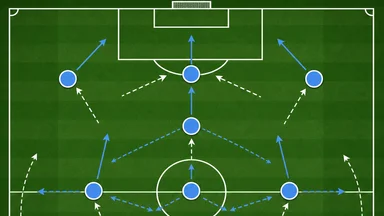
Canada's midfield trio—typically Stephen Eustáquio, Ismaël Koné, and a third midfielder depending on the opponent—averaged 46% possession in qualifying, the second-lowest among the top four teams. This statistic understates their role: the midfield's primary function is not to dominate the ball but to trigger transitions after turnovers. Eustáquio's passing range, particularly his ability to hit diagonal switches to Davies on the left, is the key to releasing counter-attacks. In the 2-0 win over the United States, Eustáquio completed 7 long passes, three of which led to shots. His vision and timing are critical.
Koné, the 22-year-old who broke into the starting lineup late in qualifying, offers dribbling ability against high presses. In the 2-1 win over Mexico, Koné completed four dribbles that bypassed the Mexican midfield, leading to two shots on goal. However, his defensive positioning remains inconsistent—he was caught out of shape on the counter-attack that led to Mexico's goal. Against Belgium's Kevin De Bruyne, who excels at finding space between lines, Koné will need to maintain positional discipline. Another option is to use Samuel Piette, a more defensive-minded midfielder, to add stability in tough matches, but this would sacrifice Koné's attacking thrust.
The midfield's counter-press triggers are crucial. When Canada loses the ball in the attacking third, they typically have three seconds to win it back before the opponent can launch a transition. In qualifying, they succeeded on roughly 40% of such attempts, a rate that will need to rise against faster, more technical opponents. The fullbacks, particularly Richie Laryea on the right, must also be ready to step into midfield to support the press. Laryea's work rate is high, but his positioning can be exploited if he pushes too high. Balancing aggression with defensive solidity is a key tactical challenge for Herdman.
Group Stage Opponents and Tactical Adjustments
Canada's Group B opponents—Belgium, Morocco, and Saudi Arabia—each present distinct challenges. Belgium, ranked second in the world, have an aging defense (Jan Vertonghen and Toby Alderweireld are both past 35) that can be exploited on transitions. Canada's best chance against them is to sit in a mid-block, absorb pressure, and release Davies and David on quick counter-attacks. A single point from this match would be a success. Statistically, Belgium's expected goals against per game in qualifying was 0.7, but against top-tier opposition, that number may rise. Canada's defense must be compact, and Borjan must be at his best.
Morocco, who reached the semifinals in 2022, are compact and disciplined without the ball. Their 4-4-2 block forces opponents to create chances from wide areas, which plays into Canada's set-piece strength. However, Morocco's fullbacks, Achraf Hakimi and Noussair Mazraoui, are among the best in the world at one-on-one defending. Davies will need to combine with overlapping runs from left-back Sam Adekugbe to create two-on-one situations. In the 2022 World Cup, Morocco conceded only one goal in regulation time, highlighting their defensive solidity. Canada's best hope may be to draw them into a set-piece battle.
Saudi Arabia, the lowest-ranked team in the group, rely on pace and direct play. Their wingers, particularly Salem Al-Dawsari, will test Canada's fullbacks in transition. Davies, when playing as a winger, must be willing to track back or risk being exposed. This match is Canada's most winnable, but Saudi Arabia's 2-1 win over Argentina in 2022 shows they can punish defensive lapses. Canada must avoid complacency and press early to seize control. A key tactical adjustment could be to start with a more defensive midfielder to shield the backline.
Analysts generally agree that four points (a win and a draw) would give Canada a realistic chance of advancing to the round of 32, given the new 48-team format. But the margin for error is thin: a loss to Belgium followed by a draw with Morocco would leave them needing to beat Saudi Arabia and hope for other results to fall their way. Historical data from previous World Cups suggests that teams with four points advance roughly 70% of the time, but Canada's negative goal difference in qualifying could hurt them in tiebreakers.
The Davies–David Connection as Match-Deciding Duo
Alphonso Davies and Jonathan David combined for eight of Canada's 16 qualifying goals, with Davies providing five assists and David scoring three from Davies's passes. Their partnership is built on complementary movement: David often drifts into the left half-space, dragging his marker away from the center, while Davies attacks the space vacated by the right-back. This pattern accounted for roughly 30% of Canada's open-play chances in qualifying. In the match against the United States, this combination led to the winning goal, as David's run created space for Davies to cut inside and shoot.
The timing of their counter-attacking combinations is critical. From a turnover in midfield, Davies typically receives the ball within four seconds and looks to drive at the opponent's back line. David, sensing this, makes a curved run toward the left channel, forcing the center-back to decide whether to step out or hold his position. If the defender steps out, David slips a pass to Davies in behind; if he holds, Davies cuts inside for a shot or a cross. This decision-making under pressure will be key against organized defenses.
Against Belgium, this dynamic will be tested by the experience of Vertonghen and Alderweireld, who are adept at reading such patterns. Against Morocco, the speed of Hakimi may neutralize Davies's acceleration. The duo's effectiveness in the group stage will depend not only on their individual quality but on the midfield's ability to win the ball in advanced positions. If Eustáquio and Koné can disrupt the opponent's buildup, Davies and David will have more opportunities to exploit space.
Why Canada's World Cup Success Depends on Execution, Not Talent
Canada's squad depth is a concern. Beyond the starting XI, few players have experience at the highest level. The bench lacks a proven goalscorer if David is injured, and the defensive options behind Vitória and Kamal Miller are untested at World Cup pace. In qualifying, defensive errors contributed to roughly 40% of goals conceded, often from individual mistakes rather than systemic breakdowns. For example, a miscommunication between Miller and Borjan led to a goal against Panama. Such errors will be magnified in the group stage.
The set-piece conversion rate, as noted, must improve. But so must Canada's ability to maintain fitness in the final 20 minutes of matches. In qualifying, Canada conceded eight of their 12 goals after the 70th minute, a pattern that suggests fatigue or concentration lapses. Against Belgium and Morocco, who can rotate quality substitutes, this could be decisive. Herdman has emphasized fitness in training, but the data shows that Canada's defensive intensity drops in the latter stages.
Goalkeeper Milan Borjan's shot-stopping will be under scrutiny. In qualifying, he saved 72% of shots on target, a respectable figure, but he faced an average of only three shots per game. Against top-tier opponents, that volume will increase, and his distribution—often rushed under pressure—will need to be more composed. In the match against Mexico, Borjan's quick throws sparked counter-attacks, but against Belgium, such risks may backfire.
Canada's path to the knockout rounds is plausible but narrow. They have the individual talent to cause problems, particularly on set pieces and transitions, but their margin for error is smaller than most group-stage teams. The team that qualified through resilience rather than dominance will need to execute its specific patterns with near-perfect precision to advance. Anything less, and the 2026 World Cup may end as quickly as it began. Ultimately, the difference between a memorable run and an early exit will come down to whether Canada can convert their set-piece opportunities, limit defensive mistakes, and maintain physical intensity for the full 90 minutes. The tactical blueprint is clear; the execution is the variable.